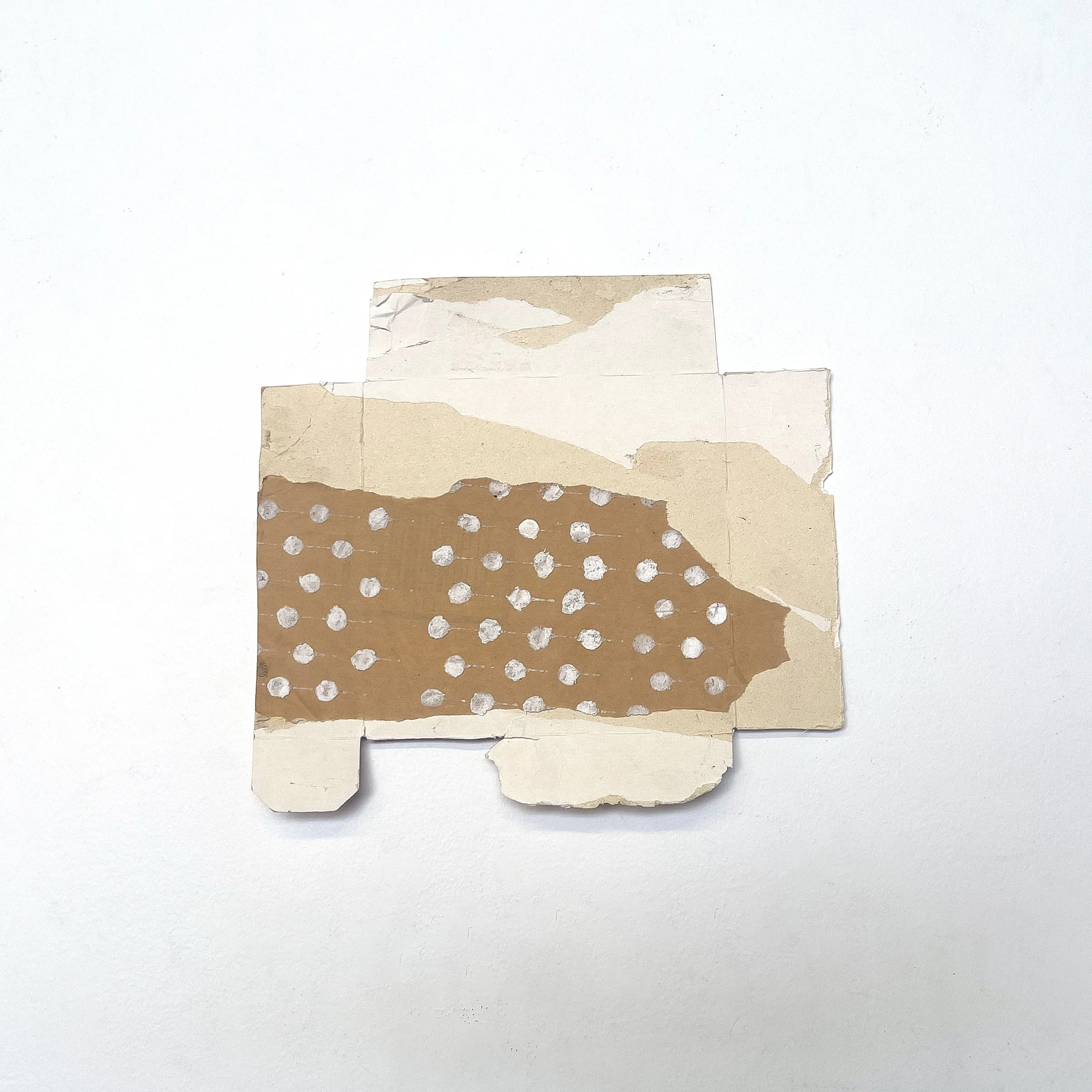
These works are part of my ongoing “Daily Practice” project, started in 2021. Working with humble materials gathered from my immediate surroundings such cardboard, tape, paper scraps, and other studio remnants. I build collages that explore the relationship between memory, material culture, and the abstract construction of space. The spaces that emerge are neither wholly real nor entirely imagined; they exist between lived experience, recollection, and speculation.
Each composition develops through an improvisational process shaped by play, repetition, and self-imposed constraints. Cutting, tearing, layering, and rearranging become ways of thinking through the work rather than composing an image. The resulting forms remain deliberately provisional: fragmented structures that seem to be continually assembling and coming apart. In this sense, the collages resist closure, inviting viewers to navigate them through association, projection, and sustained looking rather than fixed interpretation.
The materials themselves are integral to this inquiry. Drawn from the ordinary residue of everyday life, they carry traces of use, wear, and time, functioning as modest repositories of lived experience. Their imperfections and histories become active components of the work, creating a dialogue between the personal and the collective, the ephemeral and the enduring. Rough cardboard surfaces meet smooth paper planes. Geometric cuts collide with organic tears. Muted tonalities are punctuated by graphic interventions of tape and line. These formal tensions produce images that are at once solid and fragile, structured yet unstable.
Works such as DP_993, DP_992, and DP_991 exemplify this approach. In DP_993, a torn cardboard form encounters an undulating black shape that suggests movement, displacement, or transition. DP_992 layers paper, cardboard, and strips of black and beige tape into a shifting arrangement that appears to both cohere and collapse. In DP_991, the interplay between coarse corrugated cardboard and delicate paper surfaces evokes a landscape in flux, hovering between abstraction and recognition.
Rather than depicting specific places or events, these collages operate as provisional archives assembled from the overlooked materials of everyday life. Through accumulation, fragmentation, and transformation, they bring together traces of the past, the contingencies of the present, and the possibility of imagined futures. The works propose collage not simply as a method of construction, but as a way of thinking through time, the instability of memory, the poetics of ordinary materials, and the continual remaking of meaning.